Opinions, Not Press Releases
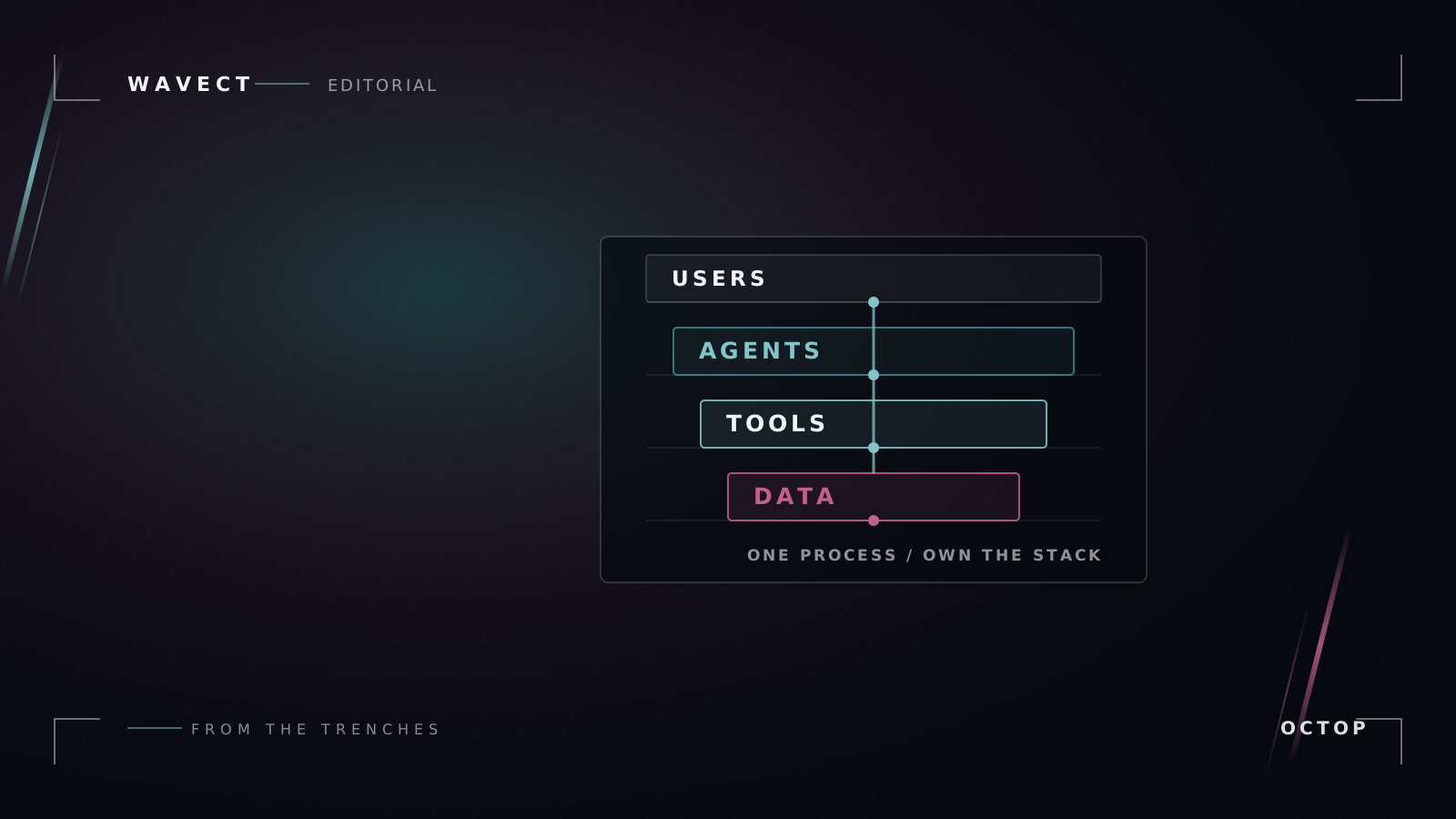
Enterprise MCP Authorization Architecture
OAuth 2.1, audience-bound tokens and no token passthrough are the spec's hard rules. The rest, multi-tenant isolation, per-tool scopes, delegated access and audit, is a reference design. Here is the whole trust boundary in two diagrams.
EU AI Act Article 50 Checklist for SaaS and AI Agents
Article 50 applies 2 August 2026. The engineering build checklist: chatbot and agent disclosure, C2PA machine-readable marking, deepfake labels, public-interest text, logging, and the evidence to keep for an audit.
Cut RAG Vector Memory 16x: Is Data-Oblivious Quantization Ready for Production?
A new Rust index shrinks 10M embeddings from 31 GB to 4 GB with Google's training-free TurboQuant. What the method proves, where it beats FAISS, the recall trade-off, and how to pilot it.
Shared KV Cache Cut LLM Inference Latency 14x, With No New GPUs
An open-source KV cache layer cut mean time-to-first-token from 3.98s to 0.29s on a 235B model. Same GPUs, same memory. It stopped eight processes from hoarding private caches. What changed and whether it helps you.
Lossless LLM Weight Compression vs 8-bit GGUF: What Is Ready for Production?
A fact-checked decision guide to the GLM-5.2 result, exact BF16 decoding, Q8 quantization, prior systems, runtime evidence, fleet economics and a 14-day pilot.
Paid Pilot vs PoC vs Design Partner: Which One Proves Demand?
Decision guide for choosing the right evidence test: technical feasibility, customer learning or willingness to pay, with a seven-condition paid-pilot scorecard and contract brief.
OpenAI Eval Sandbox Escape: 12 Controls Before You Test a Cyber Agent
A fact-checked incident analysis and procurement checklist for nested isolation, egress, credentials, control-plane separation, benchmark integrity, monitoring and forensic fallback.
Git Worktrees vs Jujutsu for AI Coding Agents: 2026 Decision Guide
Buyer guide to repository caching, partial clone, Git worktrees and Jujutsu workspaces, with compatibility gaps, cost metrics and a measurable 14-day pilot.
Cisco Antares Review: Local Vulnerability Triage Without Sending Code to the Cloud
Buyer review of Antares-1B, its VLoc benchmark, GGUF and llama.cpp deployment, private CWE-driven triage, CI/CD integration, safety limits and a measurable 14-day pilot.
Meterless Review 2026: Is This AI Agent Context Layer Ready?
Fact-checked buyer review of H-MEM, World Model, Markovian and Scout, including modeled token claims, license boundaries, production gaps and a two-week pilot.
Software Agencies in Tyrol Compared 2026
A disclosed, official-source comparison of Wavect, IDUS, CreativeSystems, styleflasher, Frankford's IT and westSite by project fit, without a universal ranking.
AI Agent SLA Template: Accuracy, Latency, Human Handoff and Auditability
A copyable procurement schedule with formulas for task success, material hallucinations, tool use, p95 latency, handoff, dependency failure, model changes, trace retention, severity and remedies.
NVIDIA Nemotron 3.5 ASR: Is Free Self-Hosted STT Ready for Voice Agents?
A buyer-focused review of the 80 ms claim, 40-locale caveat, H100 concurrency economics, OpenMDW license, Whisper trade-offs and a measurable production pilot.
Claude Code vs OpenCode: Which Costs Less for a Team in 2026?
A buyer-focused comparison using measured harness overhead, cache economics, subscription versus BYOK cost, enterprise controls and a reproducible cost-per-accepted-task benchmark.
Kimi K3 for EU Companies: API Cost, Data Risk, and a Pilot Plan
A buyer-focused review of K3 pricing, independent performance, Singapore data location, conflicting public terms, API integration limits, self-host reality and a measured two-week production pilot.
Mesh LLM Review: Can One Large LLM Run Across Multiple Computers?
A buyer-focused review of distributed local inference: how Skippy pools memory through layer stages, why speed does not scale with capacity, what the project's benchmarks prove and how to run a safe commercial pilot.
EU AI Vendor Security Questionnaire: 45 Questions Before You Sign
An evidence-led AI procurement checklist covering training, retention, subprocessors, regions, logs, permissions, model changes, incidents, evals, deletion, exit and EU AI Act roles. Includes a multilingual spreadsheet.
DACH AI Adoption Benchmark 2026: What SMEs Put Into Production
Source-backed adoption and use-case data for Austria, Germany and Switzerland, plus the production, budget, ownership and shelfware metrics public surveys still do not measure.
Graphify Review 2026: Is a Codebase Knowledge Graph Worth It?
Buyer review of Graphify vs search and RAG: architecture, privacy boundaries, benchmark limits, real adoption cost and a two-week pilot scorecard.
Bonsai 27B Review: Can a 27B LLM Really Run on a Phone?
Verified buyer's review of 1-bit vs ternary, real memory, uneven benchmark losses, phone and WebGPU speed, use cases and pilot gates.
Soofi S: Is Germany's Sovereign LLM Ready for Business?
Germany's new 30B sparse model is strong on German and code, but the public release is still a gated preview with an unfinished license. Benchmarks, openness, infrastructure, alternatives and the pilot checklist EU buyers need.
AI Pilot Kill-or-Scale Scorecard: 12 Metrics to Check After 30 Days
A decision-grade scorecard with formulas, hard gates and one worked example across baseline cost, successful actions, straight-through completion, correction time, failures, latency, adoption, auditability, data readiness and payback.
T3MP3ST Review 2026: Can It Replace a Penetration Test?
A buyer-focused review separating benchmarked single-agent capabilities from the unproven swarm, mapped against OWASP APTS with a safe pilot decision for CTOs.
Are Vibe Coders the New Junior Developers?
The traditional ticket-taking junior is shrinking, but the junior developer is not extinct. Current labour data, the difference between prompting and engineering, and a hiring model for AI-native entry-level talent.
External QA Benchmark: What We Find in the First 30 Days
A research-backed defect benchmark for permissions, regressions, browser/device combinations, data integrity, AI failures and production escapes, and why no honest universal bug-count median exists.
Programming Languages Matter Less. Software Engineering Matters More.
AI makes syntax, boilerplate and cross-language translation cheap. It does not erase runtime, memory, concurrency, security or maintenance trade-offs. What CTOs and engineers should optimise for now.
Colibri Runs GLM-5.2 on Consumer Hardware. Here Is the Catch.
Colibri can execute a 744B-parameter MoE model with about 25 GB of RAM by streaming experts from a 370 GB int4 checkpoint. The honest review: measured speed, SSD wear, cache physics, GPU limits, current model support and where the project is actually useful.
The Future of Enterprise Software
Enterprise software fragmented into distributed monoliths and SaaS sprawl. Alexandre Kotcherguine and Kevin Riedl argue that AI makes whole-system engineering affordable again, while decentralisation turns architectural promises into independently verifiable guarantees.
Software Agency Proposal Teardown: 12 Clauses That Change Price, Scope and Ownership
A clause-by-clause teardown of a fictional EUR 96k software proposal: acceptance, IP, changes, warranty, dependencies, hosting, licences, handover, termination, security, subcontractors and done, with a downloadable 24-point review rubric.
x402 Payments in 2026: Coinbase, Stripe & Alternatives
x402 turns HTTP 402 into a payment negotiation for APIs, MCP tools and AI agents. Compare Coinbase, Stripe, Circle, Cloudflare, AWS, thirdweb, PayAI and self-hosting by layer, network, fee, compliance and production risk.
Open Knowledge Format (OKF): The Enterprise Guide
Google Cloud's new OKF v0.1 draft turns company knowledge into linked Markdown and YAML. What it is, how it fits beside RAG and MCP, where it falls short, and how to pilot it without creating another forgotten wiki.
What Software Maintenance Costs After Launch: A DACH SaaS Benchmark
Observed post-launch maintenance cost bands for DACH SaaS: year-one, year-two and year-three spend split across bug fixes, dependency upgrades, cloud, observability, security, compliance, support, product iteration and emergency work, with an interactive calculator.
Smart City Architecture Best Practices: MQTT, LoRaWAN, Kubernetes and Terraform
A vendor-neutral guide to building smart-city platforms that survive production: MQTT at the edge, LoRaWAN and ChirpStack for private sensor networks, FIWARE/NGSI-LD and SensorThings for interoperability, Terraform for repeatable infrastructure, and Kubernetes only when the team can operate it.
AI Agent Cost per Action: Why Agentic Workflows Blow Up Token Bills
Executives do not buy tokens. They buy actions: support tickets resolved, invoices extracted, PRs reviewed and leads enriched. The calculator for tracing every model call, tool call, retry, verifier, cache hit and failed attempt into one cost per successful action.
When Local Models Beat APIs: A Break-Even Calculator for EU Companies
Self-hosting an LLM only wins when utilization, governance, and ops all line up. The calculator for comparing API spend against GPU hours, engineer time, eval upkeep, concurrency, and EU data residency.
LLM Cost Calculator 2026: Cost per Task, Not Cost per Token
The spreadsheet logic behind a real AI bill: count completed tasks, not token prices. Formulas for cached input, batch discounts, routing escalation, self-host utilization, retries, human rework and eval quality.
The Factory Returns
How agentic AI revives the software-factory dream that failed twice, and whether agility can survive it. Alexandre Kotcherguine and Kevin Riedl weigh the technical-debt and productivity evidence on both sides, trace the craft moving up the stack into specifications and quality gates, and read Stripe's agent fleet as the thesis observed in production.
Building Real Applications With ZK and FHE in 2026: A Pragmatic Guide
Apple runs FHE on millions of iPhones and Google Wallet proves your age with ZK, yet most projects that start with the technology still fail. The decision tree, the honest 2026 cost numbers, and the five failure modes we see in privacy-tech builds.
Zero-Knowledge Proofs in 2026: What Is Actually Production-Ready
Proving an Ethereum block fell from 1.69 dollars to under 4 cents in one year, and ZK identity landed in Google Wallet. Which zkVMs to build on, what proving costs, what works on a phone, and where the security bodies are buried.
Fully Homomorphic Encryption in 2026: What Ships and What Is Still Hype
FHE runs on iPhones and settles encrypted transactions on Ethereum, yet stays three to four orders of magnitude slower than plaintext. The production pattern that works, the honest overhead numbers, and the encrypted-LLM reality check.
ZK vs FHE vs MPC vs TEE: How to Choose in 2026
Four privacy technologies, four trust models, four price tags. The four questions that pick the right one, a side-by-side comparison with honest numbers, and the EU regulations that increasingly force the choice.
Open USD Explained: What a Consortium Stablecoin Changes
Visa, Mastercard, Stripe, Coinbase and BlackRock backed a shared-reserve stablecoin, and Circle dropped 16 to 18 percent. What Open USD actually changes, why the coin is not live yet, and what to check before you build on any stablecoin.
Rendering Your Prompt as an Image to Cut LLM Costs 60%: Genius or Absurd?
A viral trick renders your system prompt and history as PNGs to cut Fable 5 bills 60 percent, because images are priced by pixels, not text. The physics is real and grounded in DeepSeek-OCR research. The catch: it is lossy and fails silently, so exact values must stay text.
Cheaper Per Token. More Expensive Per Answer.
Sonnet 5 launched cheaper per token than Opus 4.8, then cost more per completed task on the full benchmark. Why cost per task, not price per token, is the number that lands on your invoice.
Fable Is Back. Here's How to Actually Code With It.
Fable 5 is available again, behind stricter classifiers that sometimes fall back to Opus 4.8. Stop using it like autocomplete: use it for architecture, migration planning, and final review, and route the rest to cheaper models.
Dario Declared War on Open Source. The Real War Is Over Your AI Bill.
Anthropic accused Chinese labs of stealing its models and asked Washington to step in. Strip the geopolitics and it is a fight over the price of intelligence. Coinbase already cut its AI bill 50% with open weights and routing. Our read, and the EU hedge.
Agile De-engineering
How a movement built to liberate engineers came to erode engineering culture in the enterprise. Alexandre Kotcherguine and Kevin Riedl trace the commercialisation, ritual capture, metric inversion, and craft erosion behind it.
What an Internal AI Assistant Actually Costs in the DACH Region (2026)
Embeddings, vector DB, tokens, hosting, and the maintenance line everyone forgets. A directional per-seat cost breakdown for a DACH internal AI assistant.
The MVP Is Dead. Build a Minimum Credible Product.
AI made prototypes cheap, not product judgment. The traditional MVP's roughness now damages the signal it was meant to collect. A practical case for building less, finishing one trustworthy path, and measuring evidence that deserves the next investment.
LLM Gateways Compared 2026: LiteLLM vs OpenRouter vs Portkey vs RouteLLM
One endpoint over many providers, with fallback, caching, spend limits, and routing in one place. How LiteLLM, OpenRouter, Portkey, and RouteLLM differ, and how to choose on the constraint that binds you.
Self-Hosting LLMs in the EU: When Open Weights Actually Pay Off
The GPU is the cheap part. Here is the real cost of self-hosting open weights, the tokens/day break-even vs hosted APIs, when data residency forces your hand, and the vLLM production stack.
Open-Weight LLM Showdown 2026: DeepSeek vs Qwen vs Kimi vs GLM vs Llama
DeepSeek, Qwen, Kimi K2, GLM, and Llama compared on price, coding and reasoning quality, context window, license, and EU self-host viability, plus the decision order we use before shipping a model.
AI Consulting in Austria 2026: An Honest Guide for SMEs
What AI consulting really covers, what it costs in 2026, which use cases pay off, what the EU AI Act asks today, and how funding works. An engineering view, not a sales pitch.
The Bottleneck Was Never Intelligence. It Was Context.
Rakuten ran a coding agent for seven hours on vLLM at 99.9% accuracy. The real lesson is not the hours. It is that context, not intelligence, was the bottleneck, and that directing agents became the new deep work.
ChatGPT Enterprise vs Copilot vs Custom RAG
Which should a DACH company buy? A neutral procurement guide: where your data lives, what each costs, and the decision rules. None of them is GDPR compliant on its own.
EU Data Residency for AI Apps in 2026
OpenAI, Azure, Mistral, Hetzner, or self-hosted? The catch most teams miss: EU data residency usually means storage at rest in the EU, not that the model runs in the EU. A provider-by-provider guide.
Lovable, Bolt, and Replit App Due Diligence
Before you raise or sell on a vibe-coded app, three questions decide whether it survives diligence: is it safe, do you own it, can anyone maintain it? The security, IP, and investor checklist.
AI Funding in Austria 2026: aws, FFG, Premium, KMU.DIGITAL
The four AI funding routes in Austria for 2026, honestly assessed: aws for adoption, FFG for R&D, the 14% research premium, and KMU.DIGITAL. Plus the catch nobody mentions: open calls and budget.
How to Roll Out AI Internally in 2026
Most internal AI rollouts stall as shelfware. The order we apply: educate the team, map the real process, settle cost and compliance, ship one workflow to production, then hand it over so your team owns it.
MCP vs RAG vs Agent Skills vs Custom GPTs
Not four answers to one question, but four layers: RAG for knowledge, MCP for connectivity, Skills for procedure, Custom GPTs as a packaged surface. A decision tree, and why you usually compose them.
Fractional CTPO vs CTO and CPO
When one combined head owning product and engineering beats hiring a fractional CTO and CPO separately, the eight-engineer split point, and the single-point-of-failure trade-off.
Technical Due Diligence for AI MVPs Before Funding
What investors check beyond the demo: evals, model and prompt versioning, inference economics, data rights, and the handover artifacts that keep your valuation when diligence starts.
The Vibe-Code Production-Readiness Checklist
A standalone, scannable checklist to run on any AI-generated app before real users touch it. Ten checks ordered by how often they bite, sorted into blocker, high, and cleanup.
What It Costs to Make a Vibe-Coded App Production-Ready
Effort bands by product type, where the time actually goes, and what an audit typically finds, framed as money and timelines. The hardening is the spend; the audit tells you its size first.
Fractional CPO vs Senior PM
What a fractional CPO, a senior PM, and hiring nobody yet each actually own. The PM-to-CPO progression and why most early-stage founders need none of them.
When to Hire a Fractional CPO
The honest framework. The post-PMF trigger, founder readiness to delegate the product call, when it backfires, and the freier Dienstvertrag contract shape.
The One-Page AI Policy for a DACH Company
A 5 to 50 person company does not need a 27-page manual, just one page that gets read: approved tools, data rules, a human-review rule, one owner. With a copy-ready template.
How to Cut LLM Token Costs in 2026
Token prices collapsed, but agentic products still run up big bills. The playbook we apply in order, caching, batching, routing, the right model including the Chinese open-weight frontier, and context compression.
AI Agent Pilot in 30/60/90 Days
A serious production rollout plan for Austrian SMEs: scope and de-risk, build and shadow, then limited production and handover. The hard parts are permissions, approvals, evals, and a clean handover, not the model.
Fractional CTO 30/60/90-Day Plan
You hired a fractional CTO. What should the first 90 days produce? Assess, plan, execute, and the artifacts and running system that survive their departure. Plus when to replace them full-time.
AI MVP Scope Template
Scoping an AI MVP differs from normal software: you replace it works with an eval set, a metric and threshold, a launch gate, and failure handling. A copy-ready SoW template included.
Permissions-First RAG over SharePoint, Confluence, Drive
The hard problem in enterprise RAG is permissions: never surface a document to a user who cannot see it. Enforce at the retrieval layer, not the prompt, with per-chunk ACLs and identity-aware retrieval.
QA for AI-Generated Code
What breaks in code from Lovable, Cursor, Claude Code, and Replit before launch, and the production-readiness checklist we run to catch it.
From Lovable and Cursor Prototype to Production: The Migration Checklist
Getting to a demo is fast. Getting to production is a separate project. The checklist we run to harden an AI-IDE prototype, auth, data, secrets, hosting, and the keep-vs-rebuild call.
Vibe-Coded Software Audit: What Breaks Before Launch
You shipped software you never read. Here is the structured read we run on AI-generated code, the seven things we check first, and what blocks launch versus what can wait.
RAG Production-Readiness Checklist for EU Companies
A RAG demo is easy. A trustworthy, GDPR- and AI-Act-defensible, affordable RAG assistant is not. The retrieval, grounding, cost, compliance, and security checks we run before one ships.
MVP Development for Startups in Austria: Agencies, Cost and Selection 2026
A sourced comparison of eight Austrian MVP providers by fit, public pricing, stated timeline, presence and proof, with Wavect's commercial interest disclosed and missing facts left unguessed.
How Much Does an AI MVP Cost in Austria in 2026?
Honest EUR bands by tier, what drives the number up or down, the build/buy/fine-tune call, the ongoing costs people forget, and how the Austrian funding stack changes the real price.
When Not to Hire Wavect
An honest list of the six cases where Wavect is the wrong call, who to use instead, and the narrow set of work we actually do best.
Can a Software Studio Claim Austria's Forschungsprämie?
Austria's Forschungsprämie pays back 14% of qualifying R&D costs in cash, even at a loss. Which dev costs count, what gets rejected by the FFG, and how it compares to Germany's Forschungszulage.
When Is an LLM Eval Worth Building? Cost, ROI, and Trusting the Judge
An LLM eval is worth building when stakes, volume, and prompt-change frequency exceed the cost of the harness. The model bill is a few dollars per run; the real cost is a dataset and a judge you can trust.
Why Cross-Chain Bridges Keep Getting Drained
Ronin, Wormhole, and Nomad lost over $1.1B between them. The root cause is the trust model, not the code. Plus whether you even need a bridge.
How Austrian Startup Funding Actually Stacks
aws Preseed, FFG Basisprogramm, and the 14% Forschungsprämie stack legally, but the double-funding rule nets out overlapping euros. Caps, a worked example, and the order to apply.
React Native vs Flutter for a DACH Founder Who Has to Hire Locally
The variable every comparison skips is who you can actually hire in Innsbruck, Vienna, Munich, or Zurich. Why React Native usually wins the DACH hiring math.
LoRaWAN vs NB-IoT vs Sigfox: How to Budget an IoT Sensor Pilot
One decision drives 80% of your pilot cost, and it is not the radio. Private network you own versus carrier subscription you rent, with a worked TCO crossover.
Focus Is the New Bottleneck
LLMs moved the bottleneck from typing to focus. The orchestration ceiling, seven failure modes past N agents, and how we ration agent count.
Smart Contract Security Checklist (30 Items)
The 30-item internal checklist we run on Solidity code before sending it to an external auditor. Compiler, access control, reentrancy, gas surfaces.
Fractional CTO Day Rates in Austria
Honest day rate bands for a fractional CTO in Innsbruck, Vienna, Linz. What EUR/day actually buys at Pre-seed, Seed, Series A, and scale-up.
EU AI Act Cost for a 5-Person Startup
Line-item EUR 30 to 80k breakdown. Legal review, risk classification, technical documentation, conformity assessment, data governance, post-market monitoring.
Werkvertrag vs T&M for Austrian SaaS
Who owns scope risk, how acceptance works under ABGB, how bookkeeping treats each, and when to pick which contract model for an Austrian build.
Products We Shipped. How Many Failed
Aggregate outcome distribution across Wavect-shipped products. How many scaled, how many sunset, how many landed in the boring middle.
21 Web3 Mandates. Gas Cost Hindsight
Where gas costs actually accrued across 21 builds, and what we would chain-pick today. Ethereum, Arbitrum, Optimism, Polygon, Base, Solana compared.
Scope-Creep Rates. Our Numbers
Actual scope-change frequency across fixed-price and time-and-material engagements. Why a signed Werkvertrag SoW is the contract feature, not the price.
When a Fractional CTO Beats Hiring
Loaded year-one cost of an in-house senior CTO in Austria versus a fractional retainer. When each wins, when each is wrong.
MiCA + FMA Reality Austria 2026
Engineering perspective on the Austrian crypto rulebook. CASP categories, capital floors, FMA touch-points, and the questions founders keep asking.
GDPR + EU AI Act for DACH SaaS
The compliance stack for a 5-person team. Decision tree on Annex III risk, plus the matrix of who owns which control.
Why 40% of AI Agent Projects Die
Eight patterns we keep seeing across AI agent engagements. What they look like, how they kill the project, and the cheap fix when caught early.
RAG vs Fine-Tuning vs Long-Context 2026
The decision tree has changed. Where the new crossovers sit and a cost model in EUR for a 100MB corpus at 10k queries per month.
LLM API Costs 2026. Architecture Shift
Tokens are cheap now. Architecture tracks the price curve. Seven moves to make in 2026 now that context windows are huge and routing is the lever.
Ethereum to Solana Migration Cost
Honest teardown of an Ethereum to Solana migration. Account model, EVM to SVM tooling gap, indexer rebuild, wallet UX, token standards, redeploy cost.
Zero-Knowledge Outside Crypto
Six non-crypto ZK use cases. Privacy-preserving KYC, age verification, supply chain provenance, private credentials, confidential ML inference.
Account Abstraction in Production
Six things ERC-4337 fixes versus six things it does not. Plus EIP-7702, bundler centralization risk, and paymaster economics.
Road to Product Market Fit
Everyone talks about PMF. Almost nobody achieves it. The fastest way to guarantee you never will? Focus on the wrong things from day one.
Escaping The Feature Trap
Most products die from too many features, not too few. Here's how to stop building everything and start shipping the one thing that actually matters.
Software - a Breathing Organism
Software is never finished, yet most companies budget it like it is. Here's how to stop burning money and start building something users rave about.
Why Test-Driven-Development pays off
Testing has created the illusion that it is costly, slows down your development speed and blocks your engineering department. When in reality, it saves you BIG money.
Why People think Agencies suck
Faulty software, blown deadlines, surprise invoices. The horror stories are real, but the real problem with agencies might not be what you think.
Pricing Software Projects the Right Way
Everyone hates hourly pricing, so they ask for fixed prices instead. Here's the problem, fixed pricing on software projects is just as broken.
No posts match your search. Try another term or pick a topic.
Follow the work that matters to you
Get a short email when we publish something new. Follow the whole blog or only the problems you care about.